
Guided Surgery Enhances Accuracy of Immediate dental Implant Placement, finds study
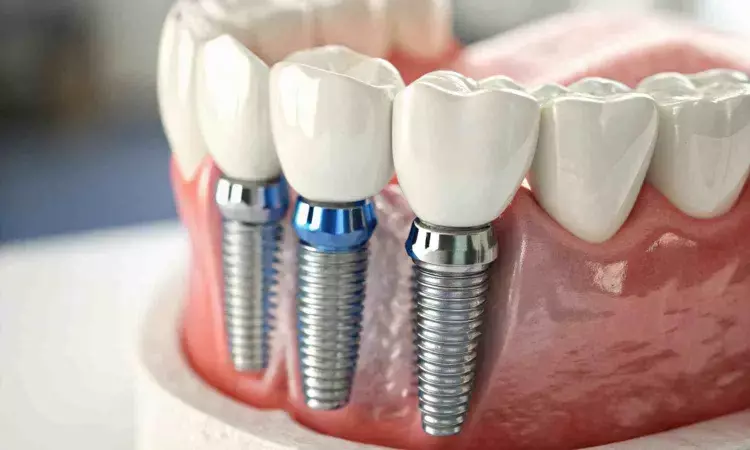


A new study published in the journal of Clinical Oral Implants Research that within limitations, guided surgery significantly improved the accuracy of immediate implant placement. Among guided approaches, robotic computer-assisted implant surgery (rCAIS) and dynamic computer-assisted implant surgery (dCAIS) showed the most favorable accuracy profiles, although sensitivity analyses limited to higher-quality evidence indicate that differences between guided protocols may be less pronounced
Immediate implant placement (IIP), in which dental implants are inserted at the time of tooth extraction, requires precise positioning to ensure long-term stability and aesthetic success. However, achieving consistent accuracy with conventional freehand (FH) methods can be challenging. Thus, this study evaluated how different computer-assisted approaches perform relative to manual placement.
The analysis included clinical studies published through March 2025 that reported deviations between planned and actual implant positions. A total of 18 studies met the inclusion criteria, encompassing 780 implants placed immediately after extraction. The dataset included six randomized controlled trials along with prospective and retrospective clinical studies and case series.
This study compared five protocols like freehand placement, half-guided static CAIS (HG-sCAIS), fully guided static CAIS (FG-sCAIS), dynamic CAIS (dCAIS), and robotic CAIS (rCAIS). Accuracy was assessed by measuring angular deviation as well as linear deviations at the implant platform and apex.
All guided approaches significantly improved accuracy compared with freehand placement. Robotic systems achieved the greatest reduction in angular deviation, lowering the average error by 3.36 degrees. Dynamic navigation followed with a 2.66-degree reduction, while half-guided and fully guided static systems reduced angular deviation by 1.73 and 1.85 degrees respectively.
Platform deviation decreased by approximately 0.68 millimeters with robotic systems and 0.71 millimeters with dynamic navigation, when compared to smaller reductions using static guides. Apex deviations were reduced by 1.43 millimeters with robotic guidance and 1.32 millimeters with dynamic systems, again outperforming static protocols.
Overall rankings consistently placed robotic and dynamic systems at the top across all accuracy measures. These findings suggest that real-time guidance technologies may offer clinicians greater control during implant placement than static templates or manual techniques.
This research also accounted for factors like implant location in the jaw, tooth position, study design, and risk of bias. Additional sensitivity analyses limited to higher-quality evidence indicated that although guided surgery remained superior to freehand placement, the performance differences among guided methods became less pronounced.
Overall, the findings support the growing role of digital and robotic technologies in implant dentistry. Guided approaches appear to provide more predictable implant positioning, which could translate into improved clinical outcomes and reduced complications.
Source:
Nava, P., Sabri, H., Hazrati, P., Nava, C., Saleh, M. H. A., & Wang, H.-L. (2026). Accuracy of static, dynamic, and robotic guided surgery in immediate implant placement: A systematic review and network meta-analysis. Clinical Oral Implants Research, clr.70100. https://doi.org/10.1111/clr.70100