
- Home
- Medical news & Guidelines
- Anesthesiology
- Cardiology and CTVS
- Critical Care
- Dentistry
- Dermatology
- Diabetes and Endocrinology
- ENT
- Gastroenterology
- Medicine
- Nephrology
- Neurology
- Obstretics-Gynaecology
- Oncology
- Ophthalmology
- Orthopaedics
- Pediatrics-Neonatology
- Psychiatry
- Pulmonology
- Radiology
- Surgery
- Urology
- Laboratory Medicine
- Diet
- Nursing
- Paramedical
- Physiotherapy
- Health news
- Fact Check
- Bone Health Fact Check
- Brain Health Fact Check
- Cancer Related Fact Check
- Child Care Fact Check
- Dental and oral health fact check
- Diabetes and metabolic health fact check
- Diet and Nutrition Fact Check
- Eye and ENT Care Fact Check
- Fitness fact check
- Gut health fact check
- Heart health fact check
- Kidney health fact check
- Medical education fact check
- Men's health fact check
- Respiratory fact check
- Skin and hair care fact check
- Vaccine and Immunization fact check
- Women's health fact check
- AYUSH
- State News
- Andaman and Nicobar Islands
- Andhra Pradesh
- Arunachal Pradesh
- Assam
- Bihar
- Chandigarh
- Chattisgarh
- Dadra and Nagar Haveli
- Daman and Diu
- Delhi
- Goa
- Gujarat
- Haryana
- Himachal Pradesh
- Jammu & Kashmir
- Jharkhand
- Karnataka
- Kerala
- Ladakh
- Lakshadweep
- Madhya Pradesh
- Maharashtra
- Manipur
- Meghalaya
- Mizoram
- Nagaland
- Odisha
- Puducherry
- Punjab
- Rajasthan
- Sikkim
- Tamil Nadu
- Telangana
- Tripura
- Uttar Pradesh
- Uttrakhand
- West Bengal
- Medical Education
- Industry
Red Light Therapy Reduces Acne Lesions with Enhanced Severity Improvement: Study
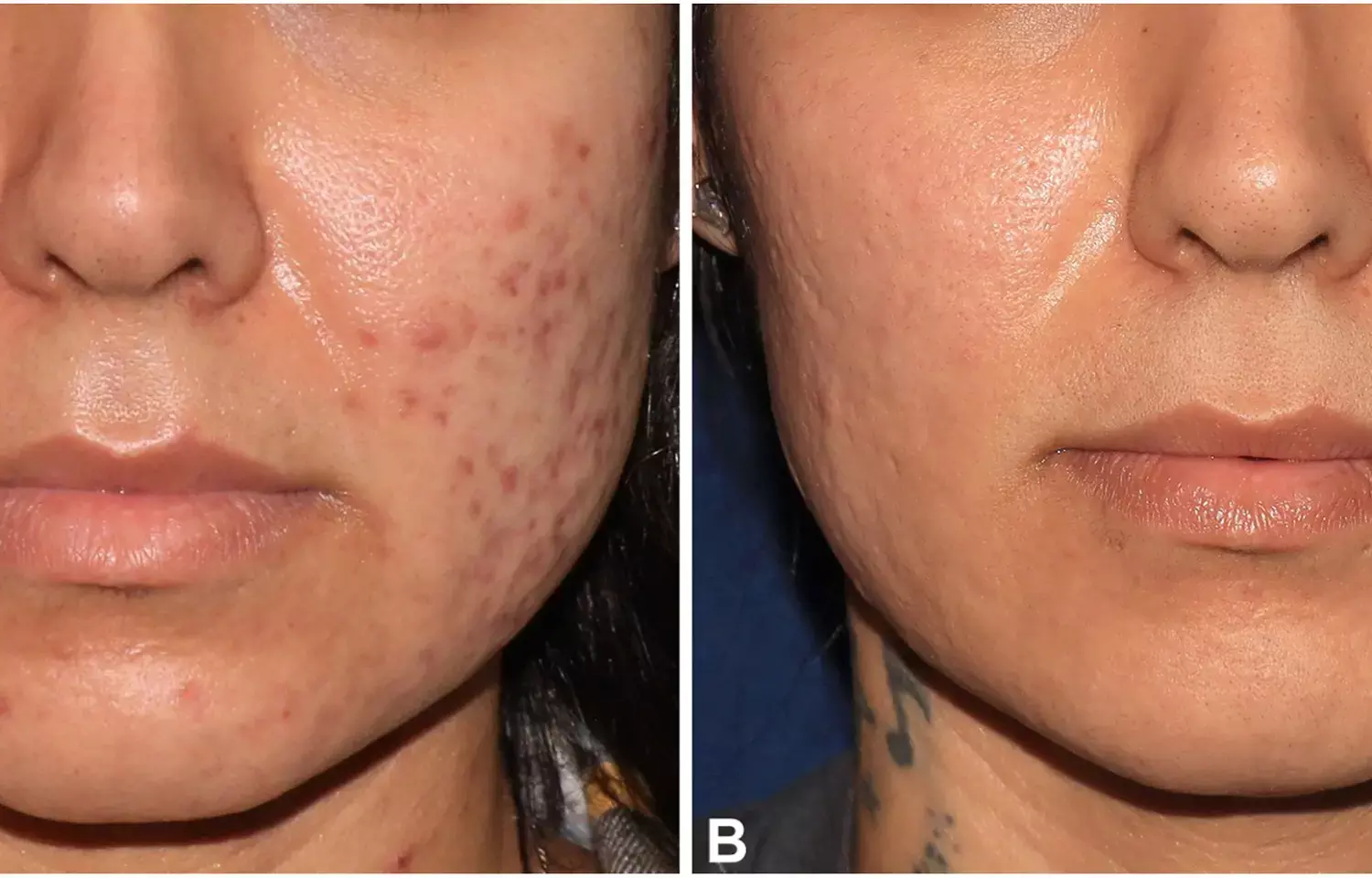
Researchers have found in a new study that daily at-home red light therapy (RBL) significantly reduced inflammatory and total acne lesions at 4 and 8 weeks. While outcomes were largely comparable to blue light (BL), RBL showed a greater reduction in median ISGA scores, indicating superior improvement in acne severity.
A study was done to evaluate the efficacy and safety of at-home treatment of mild-to-moderate inflammatory acne with an investigational combination 660-nm red/415-nm blue light-emitting diode device (RBL) compared with a commercially available 415-nm blue light-emitting diode device (BL). This was an open-label randomized-controlled trial with a 30-subject goal (n = 20 RBL, n = 10 BL). Subjects performed once-daily at-home treatments for 8 weeks, with 4-week (4W) and 8-week (8W) follow-ups.
Twenty-three subjects completed the study (n = 14 RBL, n = 9 BL). Total lesions were significantly reduced at 4W (p = .028) and 8W (p = .015) with RBL but at neither timepoint with BL. Inflammatory lesions were significantly reduced at 4W (p = .010 and p = .008) and 8W (p = .005 and p = .02) with both RBL and BL, respectively. Noninflammatory lesion reduction was not significant in either group.
No significant between-group difference in total, inflammatory, or noninflammatory lesion reduction occurred at any timepoint. Median investigator static global assessment was significantly lower with RBL at 8W (p = .015).Daily at-home treatment with RBL led to significantly reduced inflammatory and total acne lesions at 4W and 8W. Although equivalent to BL in most outcomes, RBL demonstrated a significantly greater reduction in median ISGA.
Friedmann, Daniel P. MD*; Verma, Kritin K. MBA†; Gidwani, Karan A. BS‡; Nguyen, Megan BS†; Gharibvand, Lida PhD, MS§. Comparing a Red and Blue Light-Emitting Diode Light Device With an Existing Blue Light Device for At-Home Treatment of Inflammatory Acne: An Open-Label Randomized-Controlled Trial. Dermatologic Surgery ():10.1097/DSS.0000000000005061, March 24, 2026. | DOI: 10.1097/DSS.0000000000005061

Dr. Shravani Dali has completed her BDS from Pravara institute of medical sciences, loni. Following which she extensively worked in the healthcare sector for 2+ years. She has been actively involved in writing blogs in field of health and wellness. Currently she is pursuing her Masters of public health-health administration from Tata institute of social sciences. She can be contacted at editorial@medicaldialogues.in.
Dr Kamal Kant Kohli-MBBS, DTCD- a chest specialist with more than 30 years of practice and a flair for writing clinical articles, Dr Kamal Kant Kohli joined Medical Dialogues as a Chief Editor of Medical News. Besides writing articles, as an editor, he proofreads and verifies all the medical content published on Medical Dialogues including those coming from journals, studies,medical conferences,guidelines etc. Email: drkohli@medicaldialogues.in. Contact no. 011-43720751