
Eris Lifesciences Introduces DEMELAN NEXA Serum: Next-Generation Melanophagy-Focused Approach for Melasma Management in India
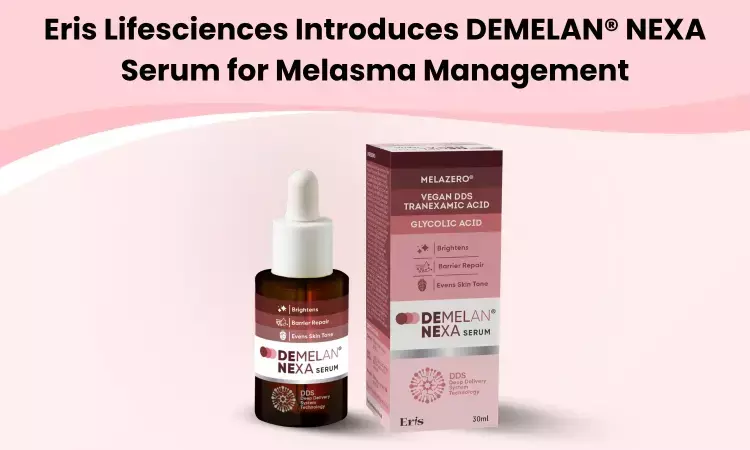


Recognizing the evolving understanding of pigmentation biology, Eris Lifesciences has launched DEMELAN NEXA Serum, a next-generation melanophagy-focused brightening serum designed for the comprehensive management of recurrent melasma, and photo-aging.
DEMELAN® NEXA Serum - available in a 30 ml pack, incorporates Melazero®, a third generation brightening agent. The serum provides a dual-action approach, promoting melanophagy, i.e., clearing existing melanin and reducing new melanin synthesis, with clinical study showing visible melanin reduction within two to four weeks.
Current Challenges in Melasma Care – Incomplete Addressal of Pathogenic Pathways
Melasma continues to pose a significant therapeutic challenge in dermatology. Characterized by chronic, relapsing hyperpigmented patches, it most commonly affects sun-exposed facial areas.1 The condition is widely recognized as multifactorial, involving ultraviolet radiation, hormonal influences, genetic susceptibility, inflammation, vascular factors and skin barrier dysfunction. 2
Despite the availability of several topical and procedural therapies, long-term disease control remains difficult, with recurrence frequently reported in clinical practice. 1, 2 One of the key limitations of existing therapies is that many primarily target melanin production rather than the removal of already accumulated pigment, leaving important pathogenic pathways insufficiently addressed. 2
Melanophagy – Novel Treatment Approach in Melasma Care
To bridge current treatment gaps, dermatological research has increasingly focused on melanophagy, a cellular mechanism involved in the degradation and clearance of melanin-containing organelles known as melanosomes. 3 Melanophagy refers to the autophagic breakdown of melanosomes within keratinocytes, enabling the removal of excess pigment from the epidermis. 3
Impaired melanophagy has been associated with pigment persistence in melasma and photoaging, making the pathway an emerging therapeutic target in pigmentation disorders. 3, 4 Growing evidence suggests that enhancing melanophagy may help improve pigmentation outcomes by addressing both pigment accumulation and ongoing melanogenesis. 3
Melazero®: A Novel Approach Targeting Hyperpigmentation through Melanophagy
Melazero® is a patented active derived from the Korean plant Arisaema amurense that utilizes a novel mechanism, melanophagy, to target hyperpigmentation. It promotes melanophagy in melanocytes, facilitating the clearance of existing intracellular melanin and simultaneously reducing melanin synthesis. Clinical studies have shown that 1% Melazero® significantly reduces melanin levels within two to four weeks, demonstrating faster onset of action and superior pigmentation reduction. Additionally, Melazero® offers good skin tolerability, making it suitable for topical use in pigmentation management.
Other Key Active Ingredients in the Formulation
The serum contains other key ingredients namely Liposomal Tranexamic Acid (Vegan DDS formulation), Glycolic acid, Niacinamide, pTerowhite®, Alpha-arbutin, Fermentex Rice Mak and Hyaluronan 16 Multi-Complex, each targeting different aspects of pigmentation and skin health. Tranexamic acid helps reduce pigmentation by inhibiting plasmin activity and lowering inflammatory mediators that stimulate melanocytes. 5 Vegan DDS Tranexamic Acid is a patented complex with 15 times higher liposomal concentration, allowing for better efficiency and enhanced skin tolerability. Niacinamide reduces melanosome transfer from melanocytes to keratinocytes, decreasing visible pigmentation while supporting the skin barrier. 6 pTerowhite® downregulates MITF expression, leading to suppression of tyrosinase and reducing melanin synthesis. 7 Alpha-arbutin interferes with melanosome maturation, reducing effective pigment production. 8 Hyaluronan 16 Multi-Complex enhances hydration and supports barrier repair, crucial for maintaining healthy skin during pigmentation treatments. 9
DEMELAN® NEXA - Technology Designed for Targeted Skin Delivery
DEMELAN® NEXA Serum also utilizes Deep Delivery System (DDS) technology, which aims to improve dermal penetration and optimize the delivery of active ingredients. DDS technology offers potential advantages such as enhanced penetration of active molecules into the skin, improved bioavailability of ingredients, controlled and sustained release of actives and better tolerability for long-term dermatological use.
Potential Clinical Applications in Pigmentation Management
By targeting pigment triggers, melanin synthesis, melanosome transfer, and pigment clearance, DEMELAN® NEXA Serum represents a multi-pathway approach to pigmentation management. Dermatologists may consider such therapies in patients with chronic or relapsing melasma, post-inflammatory hyperpigmentation, photoaging-related pigmentation, and patients requiring long-term maintenance therapy following procedural treatments.
Speaking to Medical Dialogues, Ms. Nita Borkar (President - Sales & Marketing, Dermatology Business) at Eris Lifesciences said, “With DEMELAN® Nexa serum, we aim to address gaps in the management of inflammatory and recurrent melasma. It features Melazero®, a third-generation brightening agent based on a Nobel Prize-recognized concept of autophagy, that helps to promote melanophagy and reduces melanin synthesis. Clinical studies have reported visible reduction within two to four weeks. By incorporating liposomal tranexamic acid with advanced DDS technology for enhanced delivery, this formulation offers a comprehensive approach to managing pigmentation, ensuring faster results and supporting long-term skin health.”
As understanding of pigmentation biology advances, dermatology is increasingly moving toward multi-mechanistic approaches that address both pigment formation and clearance pathways. Melanophagy-based strategies may therefore represent a promising addition to the therapeutic landscape for chronic pigmentary disorders such as melasma. 2, 3
Eris Lifesciences, a leading global pharmaceutical company, has been dedicated to enhancing healthcare through innovative, patient-centric solutions. With a strong presence in chronic disease management, Eris focuses on advancing treatments in key therapeutic areas such as dermatology, cardiology, and diabetes care, driven by a commitment to quality, accessibility, and improving patient outcomes.
- 1. What should be considered in treatment of melasma. Annals of Dermatology 22 373-378
- 2. Melasma, a photoaging disorder. Pigment Cell and Melanoma Research 31 461-465
- 3. Autophagy induction can regulate skin pigmentation by causing melanosome degradation in keratinocytes and melanocytes. Pigment Cell and Melanoma Research 33 -
- 4. Recent progress in melasma pathogenesis. Pigment Cell and Melanoma Research 28 648-660
- 5. Tranexamic Acid for Melasma: Evaluating the Various Formulations. Journal of Clinical and Aesthetic Dermatology 73-74
- 6. The effect of niacinamide on reducing cutaneous pigmentation and suppression of melanosome transfer. British Journal of Dermatology 147 -
- 7. Newer botanicals in melasma: A review. Indian Journal of Drugs in Dermatology 9 5-12
- 8. Cosmeceuticals for hyperpigmentation: what is available? Journal of Cutaneous and Aesthetic Surgery 6 4-11
- 9. The Application of Skin Care Product in Melasma Treatment. Clinical, Cosmetic and Investigational Dermatology 1165-1171